
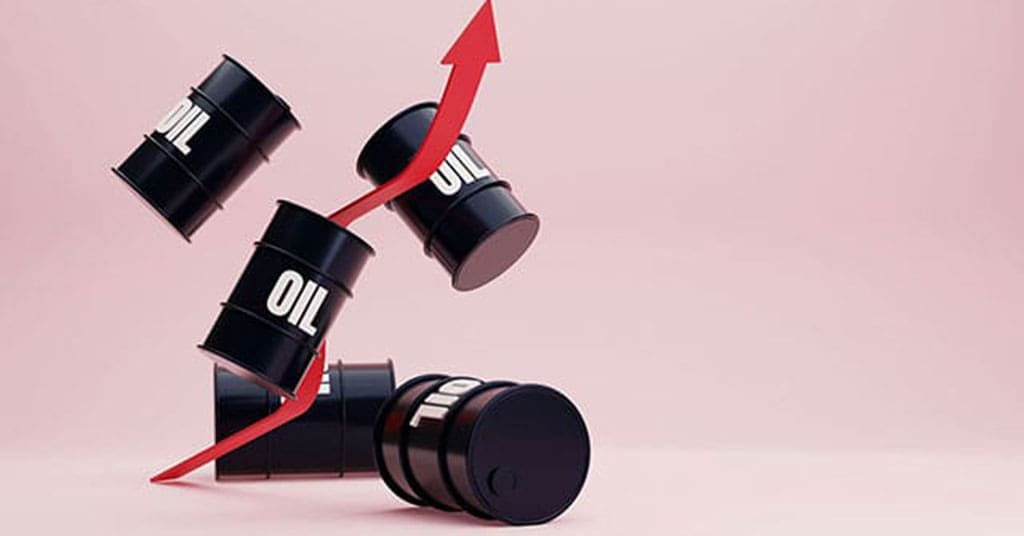
Oil prices are being propped up by geopolitics for now but when that pressure fades, the correction will be brutal
Key points
- Oil prices are being pushed up and down by global politics, not by how much oil is actually being produced or used.
- When prices swing for political reasons, we feel it quickly through gas prices, heating costs and the price of goods moved by truck.
- Canada relies heavily on oil exports to the United States, so unstable prices make it harder to plan jobs, investment and major projects at home.
- Short-term price spikes caused by conflict can look positive, but they don’t last and create uncertainty for workers, businesses and governments.
- When political tensions fade, oversupply could push prices lower, affecting government revenues and the public services we depend on.
What’s this?

Forget fundamentals. Oil prices today rise and fall on geopolitics, not barrels, and that distortion is setting the market up for a hard correction.
For an oil-producing country like Canada, that matters. Market stability is essential for long-term planning, from pipelines to production and investment. Right now, that stability is missing. Canada is a price taker in global oil markets and exports most of its crude to the United States, leaving it exposed when prices are driven by political risk rather than basic supply and demand.
Prices continue to seesaw as investors react to global political manoeuvring instead of changes in production or consumption. Diplomatic flare-ups and military threats can move markets overnight, even when supply conditions remain unchanged.
The clearest source of that risk is Iran. A prolonged standoff with the U.S. has kept oil markets on edge for months. Iran holds some of the world’s largest proven oil reserves, yet sanctions have kept large volumes off the market. Despite renewed talks over a possible nuclear deal, the risk of a U.S. military confrontation remains front and centre, which would send oil prices sharply higher, though likely only briefly.
That sensitivity was evident last Friday, when prices finished higher on renewed warnings of a possible U.S. attack. Any disruption involving Iran threatens crude flows from the Middle East, particularly through the Strait of Hormuz, a chokepoint for roughly one-fifth of global oil supply. Such a disruption would benefit producers, Canada included, but it would reflect political shock, not lasting market strength.
Even as nuclear talks continued, Washington moved to tighten pressure on Iran. The U.S. State Department announced new sanctions targeting 15 companies and 14 vessels involved in what it described as the illicit trade of Iranian petroleum and petrochemical products. The objective was to cut off oil revenues to Tehran and increase pressure for concessions. Markets responded by pricing policy risk, not changes in production.
Reporting from The Wall Street Journal suggested little movement from Tehran on curbing uranium enrichment activities, despite mounting pressure. The only sign of progress was a willingness on both sides to keep talking, largely to avoid a direct confrontation.
Timing matters. With the holy month of Ramadan approaching, the window for military action is narrowing, though the U.S. retains the ability to strike at any time. That uncertainty alone is enough to move prices. Washington’s advisory to U.S. citizens to consider leaving Iran by land only reinforced the sense of risk.
As John Kilduff of Again Capital put it, markets keep swinging back and forth on Iran. Conditions appear to improve one moment, only to deteriorate the next. The result is persistent nervousness driven by escalation risk rather than shifts in supply or demand.
Geopolitics is also reshaping oil flows elsewhere. U.S. President Donald Trump announced a trade deal with India that included New Delhi halting Russian oil purchases and lowering trade barriers. After months of pressure over India’s purchases of discounted Russian and sanctioned Iranian crude, New Delhi appears to have agreed to phase out Russian oil imports in favour of barrels from the U.S. and potentially Venezuela.
India is one of the world’s largest oil importers, and roughly one million barrels per day of Russian crude had been flowing into the country. Replacing those barrels would likely support prices in the short term. Even here, however, the driver is politics, not market fundamentals.
Energy advisory firm Ritterbusch and Associates said the near-term impact of India’s shift away from Russian oil would likely be deeper discounts on Russian crude, without significantly changing how those barrels reach global markets. Moody’s warned that an immediate suspension of Russian oil imports by India would create significant disruption, again highlighting how politically driven decisions are shaping market behaviour.
Other politically driven energy decisions underscore the distortion. The prospect of additional U.S. tariffs on countries supplying oil to Cuba, along with pressure on Mexico to halt oil sales to Havana, reflects further geopolitical manoeuvring that may influence prices without changing underlying supply-demand balances.
As Carmen Naval Reyes of the Tricontinental Institute for Social Research has argued, oil has become a strategic trophy in a broader struggle for global influence. Venezuelan and Iranian oil sit at the centre of that contest, not because of market efficiency, but because of power politics.
That is the defining feature of today’s oil market. Geopolitics is driving uncertainty and distorting prices. This phase will pass. When it does, fundamentals—global supply, demand growth, inventories and spare capacity—will reassert control. And when they do, the reality of a glut-like market will push prices lower.
Toronto-based Rashid Husain Syed is a highly regarded analyst specializing in energy and politics, particularly in the Middle East. In addition to his contributions to local and international newspapers, Rashid frequently lends his expertise as a speaker at global conferences. Organizations such as the Department of Energy in Washington and the International Energy Agency in Paris have sought his insights on global energy matters.
Explore more on Energy sector, Canadian economy, World economy
The views, opinions, and positions expressed by our columnists and contributors are solely their own and do not necessarily reflect those of our publication.
Troy Media empowers Canadian community news outlets by providing independent, insightful analysis and commentary. Our mission is to support local media in helping Canadians stay informed and engaged by delivering reliable content that strengthens community connections and deepens understanding across the country.

